Showing posts with label Feral Ideas. Show all posts

August 23, 2021

Your Breath is My Breath, My Breath is Yours

Flutes use breath to create music. Which means for the last year and a half, I have not gotten to play live for folks (unless I was over 20ft up on an outdoor balcony). I missed people waiting till a tune ends to talk with me. I missed the kids who stand right in front of the flute/whistle to hear it better. I missed the people, young and old, who sit down next to me and close their eyes to float with the music.

And then, I did get to play with a group of vaccinated musicians on an outdoor stage. We were all slightly delirious with musical joy and anyone depending on us for rides had to wait quite some time that night! (I must find a way to let little kids try out the instruments without risking infection because I was devastated when I had to turn a group of 5 year olds away even though the kids took it just fine. Maybe several of those short bamboo flute heads? Or cheap whistles that I can take home and clean in between uses?)

Soon after, I got the go ahead to play at an outdoor Farmer's Market. Almost immediately, there were kids dancing in pink tutus. And many people just enjoying the double whistle. And several friends I hadn't seen in a long time stopped to say hi. It was like being in a hazy rainbow filled other-world.

Outdoor performances and caution are my rules (easy to grab masks for when people want to talk are now part of my performance kit). Along with being prepared to change plans with little warning for everyone's safety. (Perhaps I'll be playing at Faire soon.)
But for now, we'll just enjoy a bit of distanced Musical Dreaming under the Summer Sun.

December 1, 2019

A Bit About Me

One day many years ago, I went out into the woods to teach myself to improvise. The cedar tree I sat under taught me how to listen to things I had already heard but not noticed. The birds taught me how to make each note my own song. The breezes taught me how to adapt and change to each moment. The little forest creek taught me to dance while holding still.
This is how I went feral.
After many years, I learned to share my creations with others and slowly became a composer/performer. I studied how to ornament Baroque music. I took classes on Jazz improvisation. I delighted in the many different First Nations flutes and scales in North and South America and the personal songs they sing. I learned the differences between articulations in Irish and Classical music. I jammed with musicians steeped in Eastern improvisation.
I soaked up ideas of inspiration and the creation of music from myths and fairytales.

I create art from breath and make sculpture out of air. Each song/tune/performance is individual and ephemeral. Each flute has its own voice. I use recording as a tool to expand my ideas and share unique musical moments in the wilderness with others.
"Amaltheia's Lullaby", my 1st CD uses Alto, Concert and Glass flutes recorded in my garden. Lullabies and dreams, all based on a 4-note call to Pan.
"Waking the Devas" uses Baroque, Concert and Glass flutes recorded in rain and wind, night and day, crickets and cicadas.
“A Few Flutes Shy of a Flutter”, continues the madness with new whistles and rim-blown flutes recorded over a year of wandering the forest hills.
I am currently working on a 4th album with the sound of water in every track.

What will happen next only the Stars and Time will tell.

October 19, 2019

Talking Water

(This was originally posted in June of 2013. Since I've spent the last year recording music next to running water, I decided to share this again.)

There are several small creeks and run-offs in the hills around my home. Each corner of every one sounds different. After a heavy rain, I can walk beside the streams day after day and never hear the same tune twice. The harmonies shift hour by hour as the water level sinks, progressing out to the rivers.
Roots in the Creek Bed
None of these little creeks have running water year round though there are little springs here and there that keep them from becoming bone dry and maintain a soft hum.
Usually.
For two years, we were in a drought and the creeks have not been as chatty as I'm used to. We had a good conversation last May but then they fell silent for the rest of the year. By October, only dust was moving in the rocky beds. Even the tiny springs’ tuning pitches seemed to have been lost to the heat and wind.
Dusty Dry Creek
...and dry

Green Creek
Same creek, wet...


Then, this Spring, it snowed. And snowed. And for good measure, snowed a few more times, moving planting dates later and later. And every time the snow melted, I could see more water standing in the too-quiet waterways. The slowly rising pools even began to create tiny trickling noises, little whispers and hints that the drought might be ending. Just perhaps.
Sky Between Snowfalls
Sky between snows
The cold Spring snows finally gave way to rain and to my great delight, there were a few twists in the creeks that were speaking without stop, though debris and roadside trash still cluttered most of the straight-aways, just waiting for a good rushing torrent to chase them away. Until it rained 3 inches in one day. And then rained the next day. And again two days later.
The floods were intimidating of course but largely brief. The ground soaked the rain up as fast as it could, greedy as a cat with cream or a musician with notes. And I could not help but dance for joy. The water was talking, chanting, singing in ways I hadn't heard in over a year.
Leaf Waterfall

Pictures just weren't enough. I had to take my handheld recorder out to gossip with the running waterways. The chiming sounds of water tiptoeing down ditches, the rhythmic lines from the rocky falls and the dark bass notes of the wide deep bends below the bridge all had a solo to share.

Wild and Crooked Creeks
Run-off; around 1 minute Mini Water-fall; around 3 minutes Bass Note in the stream; 7:52 min Bridge Exit

Run-off
Opening Run-off
Rocky Falls
About 1 min; the Mini Waterfall
Spring Torrent
About 3 min; Full Voice w/Bass Note
Pools and Reflections
7:52 The Final Bridge

The thunder and rain have drummed up dance forms, chansons and polyphonic-rounds in the running waters while the birds toss motives and trills down on us like confetti. The earth and sky pour joyous melodies into the little pathways of the ear and overflow the mind until nothing is left but song and water.

Sky, Trees and Talking Water

July 31, 2019

Album 3; A Few Flutes Shy...

Got the digital tracks uploaded! Have physical CDs for in person.
Here's a look at the art and program notes to the 3rd solo recording of a mad flutist!


Available at the usual music sites.

January 24, 2019

Musical Languages

Many people say music is a language. I agree. Except I would go further; Music is not just one language. It is a polyglot of many languages that all enrich each other. 

Music has a listening language which requires no performing or formal training to learn and delight in. Audiences round the world know this. This is why music is often so public; by listening we are communicating with the performers and other people who are listening. Performers spend at least the same amount of time learning to listen as learning to play. It is essential for playing in groups, for making choices in your own music and for being able to understand what the audience has to say. Listening allows the musician to adapt to the moment and how the audience completes the performance. The listening language is how we continue learning, growing, expanding in music. Listening seems passive but it is, in fact, a skill that takes practice and exercise to develop. Fortunately, listening is usually a fun and pleasant experience!

There is the language of making music, the basics of which are wired into our brains yet can take years to refine. We move to music or tap a beat or hum a tune and begin to learn new techniques for making music the day we are born. We can learn this language casually, in our “down time” or for recreation. Or we may devote large sections of our lives to study and lessons and practicing. Either way, the language of making music is a lifelong activity with no end to the new and delightful things we can learn.

Then there is the language of analysis. This can be a tricky one to learn since it is essentially about translating music into actual spoken or written language. And no matter how we try, there will always be something that won’t translate exactly. Still, the attempt to describe music opens up worlds of understanding that can transform both how we listen and how we make music. And again, this language is not exclusive to college trained performers. Anyone can speak about music, how it sounds, how it moves, how it makes us feel and what it makes us think.

Every genre and style of music is also a language, expanding the possible languages to the infinite. Listening to or making music in a different style can transform how we experienced music in the past as well as the future. We may add new ideas or “accents” inspired by other genres. We may even find some styles we don’t like but that too will add to our understanding; what we like and don’t like and why.
 
We all have the ability to learn and enjoy each and every one of these languages, with or without formal training. They combine and transform each other in a constant swirling dance. The meaning of all these languages is intangible, instantly understood and changes endlessly with each new musical experience.

September 4, 2018

Hum, Buzz and Shiver

My mother planted Yucca flowers next to my mail box this summer. (Plant exchanges and free seed fairs result in a lot of gardening whims and botanic surprises in my family.) I didn't notice right away. But then they bloomed. During an extreme drought that made the Periwinkle and Virginia Creeper show signs of wilt. These tall, elegant clusters of blooms brought out a smile every time I passed them, when other plants surrendered to lack of water and went dormant till next year.
Meanwhile, the Sunflowers bloomed. And bloomed. And bloomed. Each year I'm stunned anew at how many shades of yellow there can be in one small patch of flowers. And at how long these glories last. I am not at all surprised these flowers were/are considered grave flowers by the Kaw Nation (the people whose stolen ancestral land I live on) and as a connection to those who are gone.

And I remembered the stories of Native American flutes being made from hollowed out stalks of Yucca flowers and Sunflowers. Sometimes, flies or bees burrow into the stalks and partly hollow them out before they are picked for flute making. Making the flute a joint creation of the plant, the insects and people.

 
When a flute is played, vibrations can be felt under your fingers. Life pulsing through the instrument for as long as your breath lasts. Dissipating into the air after the final cadence. Scattering like seeds back into the earth. Waiting for the next rain to bloom all over again.


February 14, 2018

A Love Story

Some people devote themselves to one specific instrument and remain faithful to it their whole lives. Some people fall for multiple instruments and learn to juggle their various passions. I fall somewhere in between these two forms of musical devotion by playing several different types of flutes. Each flute requires slightly different adjustments in how they are played but I love the changes of tones the different materials and designs have on the basic flute sound.

The concert flute is my first love and the flute with the most flexibility in scales, accidentals and the widest range. It is the flute most people think of first and are used to seeing in orchestras. It is generally the top sound and gets some of the most ornamented parts. It can be flashy and used to imitate birds but it also is used for slow, sad tunes. It is often used in music meant to evoke natural settings. As popular as it is in Classical music, it is generally ignored by other genres such as Jazz (sax players often double on flute but solo players are rare) and folk (guitar and/or traditional instruments are much more common) so it actually adds some unusual sounds to these areas.

The alto flute has a wonderful lush sound in its lower register. I was captivated by it the first time I played one (not uncommon for those who like this instrument) but it is the heaviest flute I play. This is the flute I lift weights for. Much as I love it, playing an entire show on this instrument alone is not practical if I want to keep my arms in good working order. So this flute gets short, attention grabbing appearances mixed in with the other flutes. It is associated with darker music than the concert flute and gets used for more mysterious pieces. It is lush, velvety and surprisingly powerful.

I play 2 different sizes of glass flutes. The one in C is similar to a piccolo or a fife. The one in G is halfway between a regular flute and a picc. Their sound is bright and cheerful and a kick to play in the rain. These are both from Hall Crystal Flutes. I'm not generally a fan of piccolo sounds (I like low better) but the glass material darkens the sound wonderfully. And I admit, it is very nice to have light instruments that are easy to clean up after a long dusty day. Smaller flutes and piccs have light and bright sounds but they are also very effective at creating haunting music. The key is getting the contrast right between their brilliant sound and a darker musical line.

The one-keyed Baroque flute sounds soft and quiet up close but always surprises me with how far its sound carries. Mine was made by Daniel Dietz. Wood flutes generally have a rich dark sound which is part of what gives period and traditional flutes their distinct timbres. I am especially enchanted with how wood flutes can imitate the alto flute sound in a smaller, lighter instrument. This flute is wonderful with Troubadour tunes and other Medieval and Renaissance music of course but it really takes flight on the lively pieces.
Many Flutes
Alto (with curved headjoint), Glass flutes in G and C, Baroque flute and Concert flute.
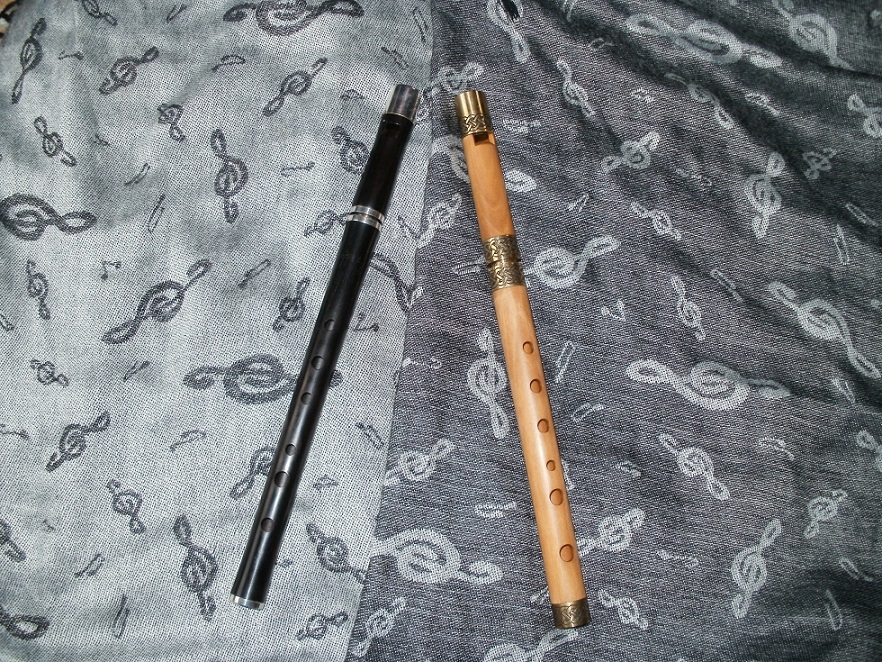
Recently, I was swept off my feet by some Penny-Whistles (also called Irish Whistle, Tin Whistle or Celtic Whistle) and rim-blown flutes. They are full of surprises and each one is different (unsurprisingly). They dance, dream and delight.
For more see Whistle While You Work or  Mythical Jacquaflute

High F Elfsong Copper Whistle, Low F MK Whistle, D Milligan Whistle
Rim-Blown Diatonic Flute based on Ancestor Pueblo/Anasazi Flute design

I have several different ocarinas (they just sort of accumulate) that are lots of fun to have on hand when the flute is just too large to be practical. They are basically extremely fancy whistles with a full octave range. Though the 10-holed chromatic wooden one I recently got goes a bit beyond that! Learning to fit tunes on this little whistle has become my version of Sudoku puzzles but much more fun. It has a soft voice that invites listeners to come close and lose themselves in musical stories.
I have a set of panpipes but I haven't really caught the trick of them. Truth to tell, I dislike how it feels to move the instrument on my lip so I leave performing on this instrument to others. They are quite fun to have though and they have taught me a great deal.
Then there are the recorders. I do play and teach recorder but we've always had a complicated relationship. They are very delicate sounding and it is surprisingly tricky to play them WELL. They take a precise touch that is rarely mastered by people who think of them as a children's instrument. It makes perfect sense to me that they were used in the same age as lutes and other subtle sounding instruments when amplification only existed in cathedrals and caves.
Panpipes, Ocarinas, Recorder
Panpipes, Ocarinas and Recorders, oh my!

I have studied a few other instruments (guitar, piano, harp, violin) over the years but never "hit it off" with them the way I did with the flute. Studying the basics on a couple of other instruments helps performing musicians be more flexible and gain more control of their instrument whether they become a doubler or not. In my case, the flute keeps tempting me back.
And so the love affair continues...

January 17, 2018

Artists of the Breath

Flute players sculpt sound into music using their breath as chisels and brushes.
Exhalations become brush strokes and molds. Vibrations become paint and clay.
Welding together timelessness and the ever changing moment.
Creating the ephemeral out of the intangible.
Wordless communication.
Singing without a voice.
Breathe and Listen.

March 16, 2017

Forest Music

"Know the Structure...Compare the piece to a forest. I first try to see the entire forest...figure out where the forest begins and ends and which kinds of trees are located where...observe the other creatures and landmarks...It becomes difficult to get lost while playing."
---Jasmine Choi

Music as a forest.
Forests have shapes and patterns. Music has form, variation, repetition and contrast.
Forests rise and fall on the landscape they cover. Music's history shapes the groundwork of each new piece. How a piece was played changes as it travels from country to country and person to person.
Forests are made up of many different kinds of trees, vines, herbs and flowers. Meadows, clearings, deer trails, bird's nests and dense thickets may emerge or vanish as we wander. Chords, harmony, other instruments, ornaments, improvisations, modulations and imitation weave throughout music. We never play the music exactly the same twice.
Forests have canopies, various under-layers, brush and floor layers that are linked together in a shifting pattern. Music has countermelodies, themes, motives, counterpoint, ostinatos, bass lines, recurring lines and notes that link to each other in complex tapestries.
The seasons transform the forest year after year. Time reshapes the music with each performance, each rehearsal, each change in musical expression.  We learn new skills, polish old ones and old music becomes new.
Other creatures live within this realm though you may not see them. Audiences (large, small or solitary practice) change our choices in every performance. Our experiences and memories of other performers and teachers (even those we have forgotten) appear and disappear like magic.
The forest is ancient and immediate. Music is ephemeral and inescapable.


June 14, 2016

Incomplete Beauty

I've been reading about Medieval music theory. For fun. Again. (Yes, I know I'm insane.)
What caught me this time is how rhythmic notation developed. Of course, music had rhythm before rhythmic notations came into use. There just hadn't been a clear way to write it down before. And developing rhythmic notation was a messy process. There were stretches when notated rhythm was rather like a written version of Morse code only more complicated. Each little blob of ink in a tune had to be counted to figure out the rhythm of any of the notes and the meaning of the lines and dots changed depending on how many there were and what order they were in (and that's the simple version).
This lead me (or returned me) to this idea: Music notation is incomplete. It has to be. Each new notation idea was created after the fact; after musicians had been playing something "that way" for so long someone decided to attempt to represent it in writing (usually in a highly imprecise way). No written piece includes all the details of the music. Think about tempo rubato in Chopin's music. Or Jazz and the art of learning to Swing a rhythm. Our rhythm notation simply has no way of showing either of these musical ideas fully. We know they are there and even mark them in the score but we cannot show exactly how to play them. They must be demonstrated in all their glorious variety.
And this is good. Music shifts, changes and creates itself fresh with every performance, rehearsal, jam session or car sing-a-long. We add to the written music and suddenly new musical ideas start to surface. Nothing is every static even if the notation on the page remains the same.

Music notation is incomplete until the moment of performance. All the striving for perfection or the definitive version that happens in many arts simply doesn't apply to music. We help to complete the music, audience and performers alike, by allowing it to sound and that is perfection enough. And each performance, public or private, is unique since what we bring to the music changes moment to moment. We break rules, add ornaments, swing a rhythm, hum along, change the words, make mistakes or even play the music as written and suddenly a new sound exists.
It seems to me that notation (or the composer) sometimes struggles to define music, to make it permanent and lasting. It is a losing battle but if we remember that notation is not complete, the written music becomes a seed that sprouts and re-sprouts endlessly. The beauty of the incomplete is that it can bring about many moments of music over and over without ever being finished.
To paraphrase The Lady's Not for Burning by Christopher Fry: "I can pass to you generations of roses in this wrinkled berry...What is not, you have in your palm. Rest in the riddle."

April 30, 2015

Daily Musings

A while back, I decided to work on memorizing more music. I've always kind of slacked in that department (Classical flute training allows this) and I've also always wished I didn't. So I've started keeping a musical journal where I record things I'm trying to play by memory along with some of the daily improvisations I create. Not sure where this will take me but I intend to share bits and pieces as I go.


Improv based on O'Carolan's "Farewell to Music"


"Carolan's Dream"


I'm mixing up the "simpler" folk tunes (some of which aren't that simple!) with Telemann and Troubadour music. The idea is that there will be some songs I learn more easily (which will hopefully encourage me) while I'm struggling with the longer pieces. In time, I hope to share a wider variety of tunes.

February 12, 2015

Ephemeral Life

Music is ephemeral. It is never the same twice. Even listening to a recording is never quite the same because the listener brings a different awareness each time they listen. They can’t help it. This is what makes music so tricky to explain and so wonderful to experience.
Many Classical musicians focus on learning to play the notes they see with as much accuracy as possible. The goal becomes to play the piece exactly as written every time. This is a good skill to have, never think otherwise, but there is more to music than that. Music is not the written notation but the moment of playing or performing including all the mistakes or even deliberate changes to what we see on the page. Music is the act of creating sound and listening to it. Improvisation is part of this and always has been. Even when improvisation isn't taught, performers end up making little tiny changes every time they play (there is no way not to). Perhaps instead of striving for note-by-note repetition, we should spend time trying to understand WHY these changes felt good or bad, what in the moment caused the music to transform and how we can make these different "interpretations" work for performers and audiences. This is the beginning of improvisation and part of what makes music an experience that is treasured.

A Couple of Examples
The Medieval troubadours are well known for setting their poetry to music but their music was not “complete” as we would understand it; they rarely included any rhythms and even wrote multiple melodies for the same poem. In other words, they improvised and used written music as a chance to expand their possible musical ideas instead of writing out a perfect version of the music. They adapted the music to their instruments and voices, they changed tones to fit the mood of the moment and treated the music like the living creature it is. There are a large number of period performers who carefully use only musical ideas from the age of the troubadours, going so far as to exclude all modern instruments and most period wind instruments since they weren’t “commonly used” at the time. Their goal is to recreate the troubadour sound as exactly as they can. This is wonderful and shows us a whole different kind of music than we are used to but I can not help feeling that the spirit of this music is in some ways being ignored. This was music that was meant to change, to adapt. If a performer didn’t play the instrument a composer had in mind, they still played the music even if they had to change the melody to do so. If only certain keys or modes worked for a specific instrument or voice, the performer could even CHANGE the scale of the piece and play the piece with different harmonies. If the audience wanted a different mood than the original piece, the music could be changed. A lament could become a dance in next to no time.
Baroque music incorporated improvisation into opera and bass lines as a matter of course. But the melody instruments were expected to change their more completely written lines too. A straight performance was often considered dull and not worth the audience's time. Today, students often spend hours researching how musicians might have improvised a piece in that day and age. But why stop there? Why limit ourselves to imitating someone else’s improvisation? Don’t mistake me, imitating is a great way to learn but then we can add our own ideas. Radical, I know, because this may well result in older pieces being made modern. But why is that always seen as a bad thing? We are modern musicians and we bring that sound with us. As beautiful as I find the Baroque style, I see no reason to rigidly make everyone follow it in every performance.

I admit, creating new music can be frightening. Some changes don’t work and some improvisations fall flat. It takes time and practice to get reliably good at improvising. But why should that stop us? We spend hours, even years, learning to reliably recreate written music after all. There is no reason to assume improvising will just come naturally without any effort. But the seed of improvisation is there, in anyone who has played one note and then another without any direction from someone else.
Improvisation and written music are not exclusive to each other and I love playing written music just as much as improvising. I find it beautiful and inspiring to play and hear music others were trying to share. But I know that I will never create a carbon-copy performance of any piece and I wouldn't want to even if I could. New sounds, new ideas and new music leap out of performances of old music. Some are sweetly similar to the sounds that created them, some are radically different. The musical possibilities and knowledge that this music will never be exactly the same again is what makes the experience so rewarding.
We are, after all, as ephemeral as the music we love.

December 17, 2014

Music and Meditation

Today, I'm going to share one of the methods I have developed for working music into my meditation practice. Music isn’t required for meditation of course and I don't always use it (how repetitive that would be!) but I tend to incorporate music into most things I do at least in some small way.
Meditation is about calming the mind. Some people do this by “emptying” their minds of all thoughts, sometimes by counting breaths. Others do it by focusing on a single simple thought or image. For the record, I prefer using simple pretty images but feeling them rather than seeing them. I tend to get bored when thinking of “nothing,” and counting breaths is too much like work (all that counting explains why musicians get kind of focused and spacey at the same time while playing) for me to really settle into it.

Music can be added to either the mind-emptying or the focusing approach to meditation. The idea is to allow the music to fill your mind and let the flow of notes become your thoughts. I’m not talking about imagining a story to fit the music (although that is a useful trick too) but experiencing the music on its own terms. Now there are several books out there that try to pin down exactly what impact different types of music have on people. They often go so far as to say you should listen to music in certain keys for certain issues (completely ignoring the fact that most Classical pieces modulate quite a bit and some are almost never in the key that is listed in their name). The trouble with this approach is that no two people respond exactly alike to the same music. A piece I think is happy may sound aggressive to someone else. A piece can be thoughtful and calming or sad and depressing depending on who listens to it. What this means is you will have to test out these pieces for yourself. Keep in mind that different instruments and performers can change a piece wildly. I typically prefer music with overlapping lines and repeating arpeggios that aren’t too fast but some single line or fast pieces work wonderfully. The key is that the music is enthralling in some fashion.

I haven’t yet figured out how to fully describe the music I like using for meditation so I’m going to periodically share short lists of pieces and recordings that I find to work well. I've been using a lot of Classical music but other genres work just as well. I find it easier to use instrumental pieces than vocal but some vocal pieces are wonderful (I'll share some of those in later posts). My friends/guinea pigs who tried these pieces out were generally surprised when the music ended, even the longer Classical songs, saying they didn't think that much time had gone by. This is one reason I think these pieces are effective as meditation support.

-Dunmore Lassies from “The Long Black Veil” performed by the Chieftains and Ry Cooder. This is one of my favorite pieces of music in general. It starts with a beautiful guitar and flute duo then builds and grows in absolutely amazing ways. It is about 5 minutes long.
-J. S. Bach’s Sonata in G Major for Two Flutes and Continuo BWV 1039. The flutes and continuo parts weave around each other in wonderful ways. The third movement is especially hypnotic but the entire piece works. This piece is about 12 minutes long.
-Telemann’s Concerto for Flute, Oboe d'amore, Viola d'amore, Strings and Continuo in E Major. The second movement may be a bit lively for some but I find its energy fits just fine after the first movement. This piece is about 15 minutes long.

Have fun with this idea. Don't get stuck on my recommended pieces though. If they don't work for you, try something else.
When looking up Classical pieces, be aware many on-line sites don't bother listing composers. In pop music, the performer is the more important information for finding the music so they got into the habit of skipping the composer. But in Classical music, if you don't know the composer, you won't find the piece (the names are just too similar). They are getting better on this issue but you may need to hunt a bit. Some sites DO include the composer's name as part of the name of the song or album so that can help you find what you are looking for.


November 15, 2014

What Do You Hear?

I teach a music history class for non-music majors. One of the first things I make my students do is talk about music. I play musical examples for them and say "tell me what you thought". And silence falls.
After about five minutes of gentle encouragement someone finally gets up the courage to say "I liked it" or "I didn't like it" and I breathe a sigh of relief. If I can get them to admit they have an opinion, there is a chance they will develop some ability to talk about the music. This works even better when one student says they like a piece and another says they don't like the same one. With a little careful assistance in finding the words to describe what they heard, the class often realizes that the exact same musical moments caused both opinions. That is when they realize this class is not about right and wrong answers but about experiencing new music and learning to express their own thoughts.
Quite a few students drop at this point. The idea that their grade is at least partly based on their own opinions and observations seems to be overwhelming for them. They can't just read the book and parrot it back to me or express the same thing another student does because I ask them "why didn't you like this, because of the choppy rhythm or the dissonance?" or "what made you like this piece, the instrument sound or the melody?" The fact that there is no wrong answer to these questions doesn't help them much at first. They may have spent years in school but they have almost never had to express their own opinions. The realization that opinions are exactly what I am after startles most of them and the lack of absolute right answers appears to be terrifying to many.
 Once they get this far, they nervously ask for tips and ways to start talking about music "right". I tell them to start with the obvious, all the things that seem too blinding clear to bother describing; is the piece fast or slow, smooth or choppy, loud or quiet, consistent or changeable, name the instruments you hear and when they change to other instruments. Because when you are talking about music, you aren't actually listening to it anymore. All those musical sounds that are obvious in the sounding music aren't obvious at all once the music stops.
Words and music are two different languages and learning to translate one to the other can be tricky. Music says some things with such ease and grace that the complexity of what they are saying vanishes into simple sound. Those same ideas can take an entire paragraph to describe properly in words and even then, we often have only described the bare surface of the musical sound, not the depth of meaning (for lack of a better term) within the music.
The secret, I think, is that the meaning of the music is at least partly created by our own minds and therefore changes subtly (or less subtly at times) from moment to moment, hearing to hearing and even in retrospect. It is entirely possible to experience a piece one way while listening to it and while writing about it, experience it differently in our own memories. This can make writing about a piece seem like a fantasy or a made up answer. Which it is, of course, since we are talking about what we think about music. We are the ones creating those thoughts and therefore we are making it up as we go. And there is no wrong answer.

April 21, 2014

Dark Sky Music

Moon Rise
Rising Moon
Dark Sky Week is April 20-26
Playing flute around the middle of the night is a habit for me. One reason is I’m a night owl and this is a convenient time to get some practicing done. But the music that wells up at this time is often different than during the daylight. Pieces have life in them even when I am still learning their twists and turns. Improvisations speak more deeply and enchant me for longer. Even the technique exercises become freer and more fluid at this time of night. This is when I can imagine that only the owls and the trees can hear me. This is when self-consciousness fades away into nothing and anything is possible. On especially nice nights, I sometimes go outside and play on the patio where only starlight reflects off the flute.
Of course, I can be heard just as clearly at this time as during the sunny hours. Many, if not all, of my neighbors have commented on the “mysterious” flute player in the woods out here. Some have even told me that they love sitting out on their porches and waiting to hear the flute music roll down the hill. If anything, the darkness creates a more noticeable spotlight for the music than the brightest stage-light. But only for the sound. Most of my neighbors never guess who the musician is. Even those who know I play flute usually don’t realize it’s me until someone tells them. Why, I’m not quite sure. Unless that element of nighttime mystery crept into the music and hid my identity. This may be why I like playing in the dark. My own sense of self is less noticeable and the music can simply be another nightly creature in the woods. Raccoons and possums have wandered by as the notes tumbled round the patio. The crickets and tree-frogs keep time with the exploring rhythms. The trees dance with both the wind and the motivic melodies. Stage-lights create the illusion of being surrounded by darkness but this is the real thing. There is nothing to hide from and no reason to try.
Turn off the lights, even the spotlight, and see where the music goes.

Moon in Clouds

April 5, 2014

April Improvisations, May Compositions?

April is here at long last but the trees are still barely budded. I've been waiting and waiting for the spring storms to roll their way across the roof and inspire new notes with each thunderclap. But instead I find myself hearing gentle rains pattering lightly on the ground. Light little taps of a watery baton. The new tunes aren't flashing into my mind this season but they are slowly building up. Each note slithers its way onto the staff like seeds sliding into the ground.
My garden doesn't grow in rows since I'm much too impatient to make the plants behave. Instead the sprouts scatter over wide areas and pop up in places I'm sure I didn't plant them. But the patterns they make are all the more lovely for that. I've taken to writing several versions of a new melody idea for similar reasons. There isn't just one pattern for the notes to follow when I play and for the life of me, I can't decide on one to commit to the still paper version. But when three different versions twist round each other on the page, I am happy and content. I don't have to set these songs in stone; they can leap about into new and unexpected designs. The improvisation and the composition can exist side by side after all.
I was late ordering seeds this spring which has worked out well for once. The cold kept returning, making me grateful there wasn't much in the garden to get nipped by the frost. I feel the same about how long I took before learning to compose. I didn't study the subject in school. The rules and restrictions in those classes would have driven me mad. I understand the point of using structure to develop a creative skill (and use the idea in many ways) but the rules about which intervals could be used and the patterns of melodies that were allowed were not the structure I needed. I needed to follow the notes down into the dark depths of the musical forest, where even the deer trails disappear and learn to find my way about by listening to the notes alone. I needed to have the freedom explore the different ways the harmonies worked from year to year, within their wild home. It took a great deal of time and in many ways I am still lost in the woods but I feel at home there and I have found new and unexpected skills within my musical creations. Little sprigs of ideas appear like mushroom caps and early wild flowers after a rain. And when I let them grow at their own pace, without hurrying them, they often surprise me with their beauty.
I grow salad greens inside the house as well and this year was no exception. The broccoli raab I planted back in January has been a great and unending delight all this long winter. The window box of green florets sits beside my music stand in my practice room where I can look out the window as I work on scales and memorizing. My breath makes the leaves toss and turn at times and I can imagine the plants are dancing to the music. I've watched the winter season through that window with each practice session and gloried in the tiny changes I was seeing. And hearing.
It may have taken a long time but there is no doubt. It is the budding season, the time of new growth and new ideas. The bird-calls fill the days and the coyote-howls fill the nights. Soon, I will take myself outside to practice, to give the note-seeds room to grow and to delight in the spring.


January 1, 2013

Lullaby's Creation

All that exists remakes creation by existing. The painter, the sculptor, the gardener, the builder all transform the universe with their tales. The rock, the flower, the ice, the air redefine the world and stories they touch. This is just one of many stories that can be enjoyed or ignored as pleases.

Long before long ago could even exist, all of creation - all that is, all that was and all that may be - still lay wrapped tight within itself. Here, in this time that is not, all creation slept. A deep dreamless sleep where all awareness dissolves into the stuff that feeds the soul. But as always happens, when the soul is fed, dreams began. And within the dreams Creation met sensation for the first time. Through sensation, Creation learned to understand itself and all that was around it within the dream, for within the dream all is understood or if not understood then accepted as if it was well known. In this acceptance, Creation learned meaning and even language but only in the dream where logic twists itself into tangled spirals. And even now, that first learning still runs through all of creation’s understanding of itself and spins tiny knots into all reason and order.

Wild Raspberry Buds
But then, creation began to wake.
And for all its learning of dreams, creation had never experienced itself when awake. In the waking, creation found itself as lost as it had been at the start of the dream, now long forgotten. All experience was equally startling, joy and sorrow as overwhelming as a drop of water and grain of sand. All the colors exploded, smells wove together, taste drowned the horizon, sound cracked atoms and touch brought the world to an end or so it seemed. And then, slowly, creation began to notice something. It was more comforting than shade in summer, tasted more decadent than black raspberries, smelled more enticing than wine and was softer than flower petals. It was the lullaby. As creation listened, it began to realize it knew this music. It had been hearing this tune for longer than it could remember, longer even than it had been dreaming. Listening to this lullaby brought a sweeter comfort than creation could imagine or even knew how to long for and brought all of creation’s sharp, new sensations into a kind of order.

Wild Raspberries

And then, creation stretched. 
As it stretched, creation realized that each section of itself heard the music differently, a note here, a hold there, with timbres shifting and rolling against each other. Each move creation made changed how a part of creation heard the lullaby and how all of creation fit the lullaby together. And as each change added to how the music could be heard, creation discovered harmony and began to find the meaning that it thought it had left in the dream. So creation began to unfold and coil round and round itself to hear all the infinite changes, and at that moment made a decision. Dream knowledge said there was no end to the changes in the music or creation itself and that this variety of self and lullaby would bring joy in the deepest sorrow.

Snow Raspberries Echinacea
Berry Canes and Echinacea
So creation made a decision to create as many possibilities as it could find within itself so that it could always hear the lullaby anew. And still to this very day, that line of music, that infinite diversity, that touch of chaos, that bit of dream wisdom runs through all of creation as a gift of joy that is given to all that is, all that was and all that may be.

October 1, 2012

Female Musicians in History

Lately, more attention has been given to women in music history but nearly all of it has been on the composers. So here's a little about the performers.

Ladies and respectable women were not supposed to play music in public during various times in history, including the Renaissance. But that doesn't mean women only played music for their families. The two ideas that influenced whether a woman could play for an audience were her social class and what was considered a public performance.

Social Class and Private Concerts
First off, it was the women of the upper classes who were most restricted when making music in public. For women of the lower classes, it was another story. There are quite a few records of amateur female musicians, and nearly all the words for musician had female variants, which tells us in no uncertain terms that women were traveling and court musicians. Trobairitz were upper class poet musicians in France; menestrelles and jongleresses were wandering minstrels and entertainers in France; gliewmedens were traveling musicians in England -- just to list a few. Occupations were closely linked to family, so if a woman came from a family of musicians, she could easily be expected to learn to sing, play or write music to help support the family. If a woman played music as part of a group, especially one made up of her relatives, it was more acceptable than playing alone. In addition, there were a number of groups made up of all women that achieved widespread fame. They were more likely to gain musical acknowledgement if they had a high ranking patron (the Concerto delle Donne in Renaissance Italy is one famous group) but female groups certainly existed outside the courts of Kings and Dukes as well.
Next we have to understand how public vs. private was perceived at the time. Playing on the street for anyone who happened to be walking by was public and very risky for any female musician (and not so good for male musicians for that matter). But inviting 20 or 200 people from the “right” social class to a concert in someone’s home or court (and the occasional concert hall) was usually just fine. Even if a woman was playing. The real issue was who was going to be watching. Restricting the audience to the upper classes made it much more acceptable for women to play. It also made it more acceptable for the upper classes to listen to a lower class musician, male or female. Many male musicians owed their careers to these concerts and the female patrons who often ran them. A number of these “private” concerts became the unofficial centers of politics and government.
The other group of female musicians to be considered are the women labeled as courtesans. Courtesans in general were a class of women who were certainly not respectable, but still associated with the upper classes regularly. They were expected to be accomplished in music and art and able to hold their own in educated discussions. Female musicians could be labeled as courtesans to make it clear that they were skilled musicians and give them the ability to mingle with the upper classes even if they did not offer other services. But that courtesan label was not always very easy to live with and made it clear that female musicians were not respectable even when they were honored for their music. But to be fair, most male musicians were not thought of as respectable either.

Vocalists and Instrumentalists
Female singers in general were given a little more wiggle room simply because their voices couldn’t be replaced. Countertenors, boy sopranos and castrati were popular and could sing in the same range as women and were used for female roles at times, but their voices just weren’t the same and music fans knew this. And singing, in general, was given more respect than playing an instrument, so exceptions could be made for vocalists that would not be allowed for instrumentalists.
Just like today, various instruments were considered more feminine than others, although the rules about what made an instrument feminine were quite different. Women were steered away from any instrument that required “facial or physical contortions” which lets out nearly all the winds and brass and many percussion instruments. Flutes and cellos were right out; recorders and harps were iffy. Keyboards, small lutes and any instrument that allowed women to sit in “ladylike” positions while playing were much more acceptable. Not too surprisingly, quite a few women went ahead and learned the instrument they wanted to play in spite of these rules. There were many, many papers and treatises lecturing women for playing the “wrong” instruments.

Today's Renaissance Women making music at the Faire
Women were strongly discouraged from playing brass. Liza/Andrew of the Gaelic Brass finds it easier to cross dress than explain why a woman is leading a brass ensemble for the Mayor and Court. A tactic used throughout history.
Gwyneth the Feral Flute. One argument used against women playing wind instruments was that their clothing made breathing difficult. Many women at the Ren Fest modify our costumes in some way (one-size larger than standard, strategic lacings left loose, etc.) so that we can breathe properly. We have basically chosen music over fashion.
Ivy of Vespaer and Ivy on drum. Drum has shifted wildly over the years from men to women. Generally, the larger or more important the percussion is to the music, the more likely it was for a woman to have trouble being allowed to play.

Dulcinea. The dulcimer was one of the more approved ladies instruments although some cultures considered it too rustic for upper class women.
Apryl Knight of the Tulstin Troubadours with the psaltery and Matty Striker with the cittern. The cittern was the go to instrument in the Renaissance, similar to how the guitar is used today.
Sally Tenpenny and Apryl Knight tuning up. Guitars were more likely to be considered a man's instrument than a woman's. But guitars developed from lutes and small lutes were among the accepted instruments for women to play in many times.
Vespaer rockin' the guitar.


Learning music was often a requirement for a basic education, but making music for a living was seriously frowned upon. Male or female, musicians had something of a shady reputation even when people couldn’t live without having a personal musician working for them. Women often found it easier to step out of the spotlight to some degree by choosing their audience carefully, playing with a group or supporting other musicians. But others found that stage irresistible and proceeded to prove their musical right to be there.

August 21, 2012

Busking Thoughts


Busking is exhausting, too hot or too cold, noisy and the audience is often small. So why do I like it so much?
For one thing it inspires new music. When I first started busking, I played a lot of folk tunes, old troubadour music or Renaissance tunes. I've always liked how these tunes seemed to be related and the fit in at Festivals wonderfully. Plus the improvisations and variations I came up with made it possible to play one tune for a longer time without boring myself (or my audience!) It was a startling short hop from there to simply playing music I created from scratch. Not everything was wonderful but it is thrilling to know people were willing to listen to a tune I created. The more time I spent busking the more I improvised on my own musical ideas. The more I did this, the more I liked the music I created and before long I had a long list of original tunes I was trying to remember.
Then of course I busk because I love to play. And I like seeing people smile when they hear the music even if they don't stop. I feel like I'm doing my tiny part to add creativity and maybe even beauty to people's everyday lives, something there should always be more of.

In many ways busking is an endurance activity. Even when you only have a short time to play in, you have to keep the energy and music moving the whole time. There is no off-stage to duck into, even when you can take a break. The more involved I am in the music, the easier it is to keep the show going. When the music changes and is new, I can (and do!) stay enthusiastic about playing till I drop.
Mixing up the music I play, my own, folk, Classical and anything I've just wandered into is what keeps busking closer to a game than work. And nothing is quite as exciting as putting the flute to my face and discovering what I’m about to play along with the audience.

August 12, 2012

Rain Spell

Earlier this summer, back in the “cooler” part of the heat wave, my grandmother said this year was reminding her of the Dust Bowl days of her childhood. In the evenings, she and her siblings would lie by the window in their room while my great-grandfather sprayed the outside wall with the garden hose. The mist came in through the screen and the water pattered over them, as cool as a tune. When it gets so hot the sweat makes the flute slide right out of my hands, I selfishly want to go listen to other people play or find somewhere cool, drink something well iced and read about how music can change the weather.
            The drums, of course, are thunder. They can call it up or back it down. They speak to the sky in its own language, murmuring and rumbling or pounding and rolling. The flute is the lightning. Its melody line climbs up to the sky till it touches the clouds with one clear high note. Then in one sharp flash that lights the world up as bright as day, tumbles down upon itself into its low dark register. The two together make an old, powerful mix. Even when they try to out play each other, the rhythm and melody never quite leave each other behind, though they may overwhelm the dancers and audience. But what else would you expect from a musical storm?
            The violin’s strings and bow meet and cross, building up energy. The sound leaps out, fierce as any breeze from clashing fronts. Played to add water weight to clouds, those tense little strings draw out rich soothing tones and flashes of color, bright as lightning. The hollow body echoes as long as any thunder clap.
The tambourine, now, is a mini storm front all by itself. The tap, tap, tapping and the rattle and crash of the jingles builds up to wilder patterns, calling in the wind front that pushes all the dry thirsty leaves out in front of it. It’s a dancer’s instrument, meant to be played by hand strikes and body movement equally as they spin, leap and work themselves into a moving trance.
wind chimes
Whistling can call up the winds, especially outdoors. All those little skipping tunes make the wind want to show off its own skill. Meanwhile, a flute played indoors can cause rain. And once the rain tumbles down, I think, how sweet it will be to settle down and play a tune with the most unruly accompaniment in the world chattering away on the roof. Each tiny note from the wind chimes makes me long for just one more, and just one more…The leaves are rattling like Halloween on the trees, applauding each breeze with a standing ovation worthy of the finest virtuoso ever to grace a stage. Demanding just one more encore.
The cicada singers have taken over the chorus role, like they do every year. But even they wouldn’t mind being spelled a day or so by the voices of the rain barrels bubbling and filling. A long soak and their voices will be fresh and ready to go for the last month of their touring show. One lone Surprise Lilly has bloomed this year, out of the double rows that line the walk. All those sweet scented stage lights have gone dim, anticipating some dramatic event that will come along any moment now. They're just waiting for their final cue. And this weekend the meteors played hopscotch in the rain clouds, waiting for the overture to begin. They added their little trills and turns to the, still too distant!, harmony of the thunder, lightning and rain. 
Surprise Lilly

The rain cancelled its performance as it was starting last night. But the worst of the heat has broken and I taste less dust when I walk about, following song lines in my head. My ticket is still good, I'm sure. Maybe, maybe, maybe, I think as the birds and I whistle our way through the woods and watch the shy little clouds in the bright blue sky.